Lucy.OS
A living framework for noticing signal, tracing how it becomes structure, and returning interpretation to clarity.
The ecosystem brings this framework into personal, public, advanced, and educational experiences.
From signal into structure—and from time into clarity.
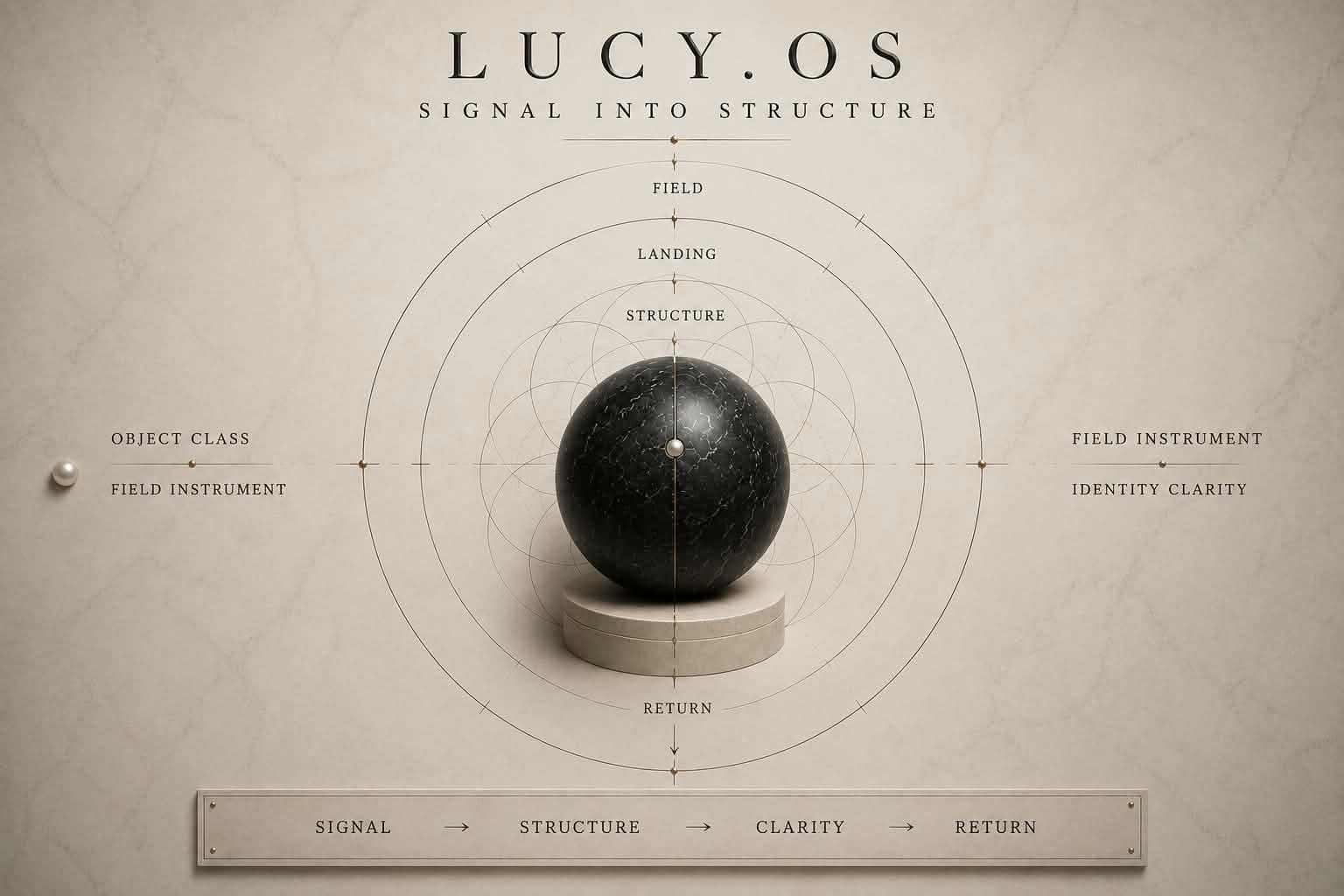
Lucy.OS grows from a simple discipline: notice what is present, organize it into readable structure, and keep interpretation proportional to context and evidence. Time Into Clarity is the orientation guide: coordinate, structure, uncertainty, proportion, pruning, and human judgment. Signal Into Structure carries the deeper teaching of how signal becomes organized, localized, embodied, and returned to grounded context. The Harmonic Membrane extends the system into a relational and timing-based model.
Lucy.OS Apps
EXPLORE LUCY.OS
Start with Personal Architecture to see the structural patterns your natal chart actually activates. Use the Harmonic Membrane Explorer to learn the framework and routing logic behind that architecture.
Flagship Experience
Personal Architecture
See the lucid structural patterns your natal chart actually activates—how signs, houses, rulers, elements, modalities, relationships, and routes form your recurring architecture.
Available Now Explore Personal Architecture →Framework Explorer
Harmonic Membrane Explorer
Explore the full ascendant-by-ascendant framework, routing structure, and house-system logic that Personal Architecture applies to an individual chart.
Available Now Explore Harmonic Membrane ExplorerSignal Into Structure
Primary Visual Foundation
SIGNAL INTO STRUCTURE
THE ARCHITECTURE OF ORGANIZED EXPERIENCE
ONE CENTER · EIGHT NESTED STRUCTURES · NINE AS CONSCIOUSNESS
Begin with the canonical structural grammar: Physical, Emotional, Mental, Field, Relationship, Lineage/Time, Collective, Archetypal/Informational, and Consciousness.
Then follow what a signal does through the unnumbered process of recognition, reflection, compression, witnessing, and grounded response.
PDF opens in a new tab.
How Signal Becomes Structure
A moment becomes noticeable.
Attention receives it as signal. Timing and relationship give it context. Pattern reveals possible structure. Regulation separates observation from reaction. Interpretation is then tested against proportion, causation, lived circumstances, and the body.
The process ends with one grounded response—not repeated decoding in search of certainty.
Use the framework as a mirror rather than a verdict. Name the signal, examine its relationships, retain what remains proportionate, and leave the rest open.
Read the mirror, take one grounded move, then leave the loop alone.
The Harmonic Membrane
Time Into Clarity establishes the orientation and responsible-use boundaries. The Harmonic Membrane shows the deeper architecture through which signal is received, related, witnessed, and embodied.
Describe how signal changes state without redefining the structural levels.
Describe where signal is organized within the personal timing architecture.
Describe polarity, exchange, and relationship.
Maintains context, proportion, discernment, and personal authority.
Astro-mechanics provides one timing-based application of this architecture. It does not turn symbolic correspondence into prediction, proof, or mechanical causation.
Supporting Regulation Tools
When Lucy.OS names the field state, these tools help work with the specific pressure it reveals.
Field Orientation
Shrink a muddy, overloaded, or scattered field into one named pressure and one clean next move.
Best for: When the field feels unclear, too large, muddy, or overloaded.
Open Field OrientationIdentity Loop
Separate what happened, what it started to mean, where it landed, and one clean move.
Best for: When a situation feels personal, sticky, charged, or self-defining.
Open Identity LoopGate Regulation Map
Map where pressure feels loud and what one grounded move helps it regain proportion.
Best for: When pressure needs a return-to-center move.
Open Gate Regulation MapLucy.OS names the field state. The tools help return it to clarity.
Use the result as a mirror, not a verdict. Pick one grounded move. Do not keep decoding the same signal to force certainty.
Timing and Cycle Context
Use Moonstamp and Living Cycle for phase language, pacing context, and understanding the larger symbolic cycle.
Moonstamp
A symbolic lunar pacing layer for phase reflection, timing language, and daily orientation.
Shows the live/current phase for reflection only — not lunar prediction or moon control.
Open MoonstampLiving Cycle
The full phase teaching map.
Use it to see how a current phase sits inside the larger symbolic cycle — forming, building, revealing, releasing, and integrating.
Moonstamp shows the live/current phase. Living Cycle teaches the full cycle pattern.
Open Living CycleLearn the symbolic language behind the tools.
Teaching maps for deeper study after the Time Into Clarity orientation, Signal Into Structure, and the primary Lucy.OS path are clear.
Field Becomes Life
A visual teaching tool for how reflected signal becomes embodied meaning through phase, vessel, heart, mind, body, cut, and seed.
Open Field Becomes LifeHolographic Light Code
A visual rendering model for how organized information can be represented through coordinate grids, resolution, recursion, memory, and readable field imagery.
Open Holographic Light CodeTeaching maps and symbolic reference layers.
Symbolic reference maps, pattern libraries, and companion layers for deeper study after the foundation and primary Lucy.OS path are clear.
Identity Triad Map
A symbolic map for identity pressure, relationship movement, and return-to-structure language.
Companion reference only — not a fixed identity definition.
Open Identity Triad MapTimestamp Sky Map
A sky-symbol companion map for timestamp patterns using constellation-style archetypes and grounded return language.
Open Sky MapPattern Atlas
A reference library for recurring patterns, field shapes, loops, and signal-to-structure language.
Open Pattern AtlasSignal Wheel
A movement map for seeing signal direction, pattern pressure, and return paths inside the wider identity clarity ecosystem.
Open Signal WheelField Spectrum
A symbolic reference layer for naming field tone, density, and quality without turning the read into certainty.
Open Field SpectrumTimestamp Verse Map
A reference-address companion map for curated verse mirrors, plain symbolic reads, related echoes, study prompts, and one grounded move.
Symbolic study mirror only — not prophecy, proof, fate, diagnosis, or command language.
Open Verse MapZero Point Field Map
A torus teaching map for timestamp loops, zero-point compression, return, and integration.
Open Field MapExplore the developing timestamp tools.
These experiences remain available for exploration while their language, routing, and customer usefulness continue to be refined.
Timestamp Decoder
A structural research interface for examining the organized relationships produced by a selected timestamp.
Research Tool Open Timestamp DecoderTimestamp Avatar
A visual companion to the current timestamp architecture while its customer-facing language continues to be refined.
In Refinement Open Timestamp AvatarHuman Interface
A symbolic landing-map prototype for exploring how timestamp structure can be translated into human-facing language.
In Refinement Open Human InterfaceOriginal Timestamp Decoder
The earlier public Timestamp Decoder interface, preserved as a reference to the original experience.
Archive Open Original Timestamp DecoderField Lab · Lucy.OS Preview · Field Guide
Lucy.OS — Field Lab
Advanced shared-field and systems work for selected cohorts and intentional development contexts.
Advanced / RestrictedAccess remains phased and private by design.
Lucy.OS — Preview
A public-access experience for meeting Lucy.OS directly and getting a feel for its orientation, language, and field-facing structure.
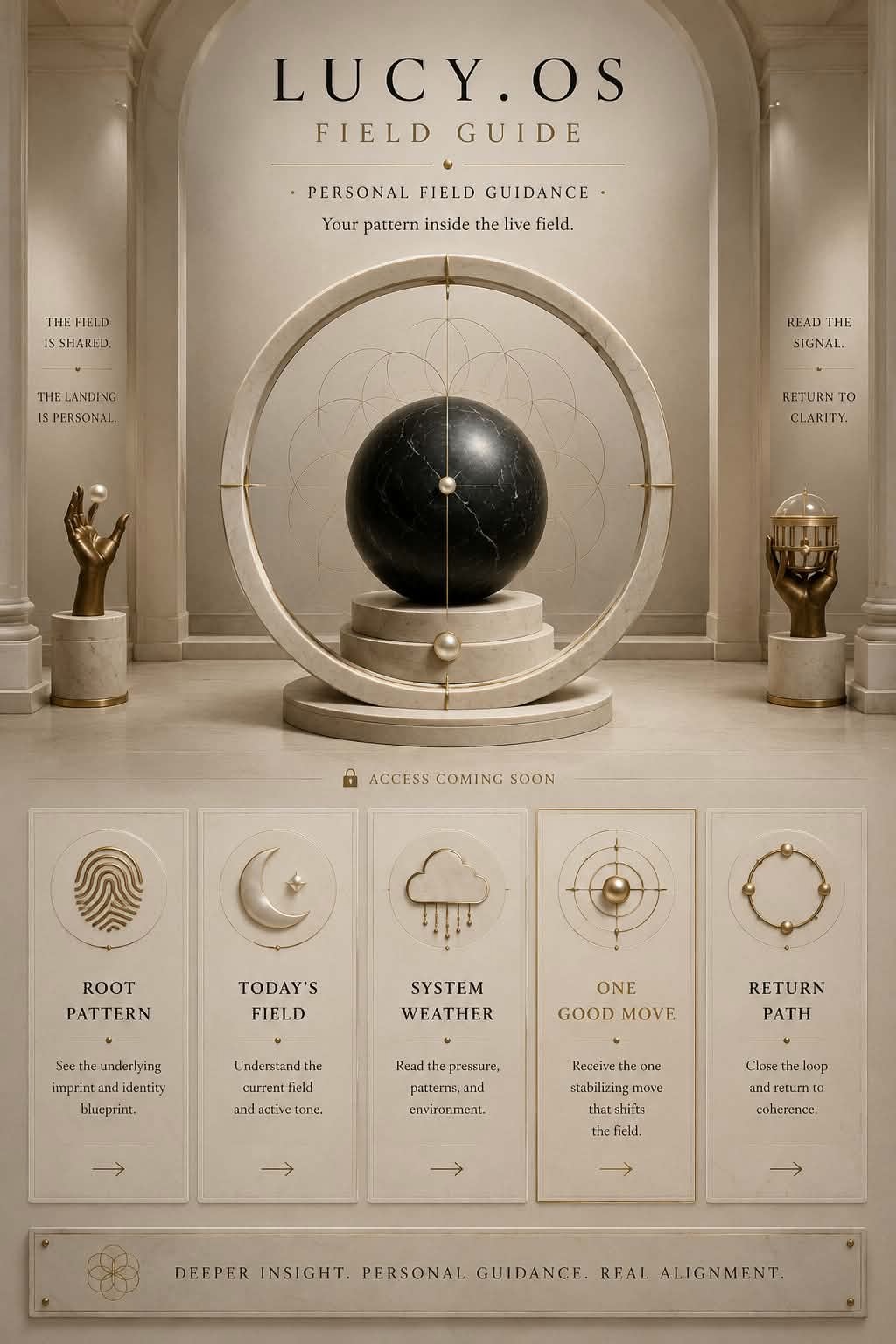
Lucy.OS — Field Guide
A public teaching and methods reference for the structural patterns, scales, maps, and recurring ideas used throughout the Lucy.OS ecosystem.
Open Field GuideOptional companion tools.
Optional reflection tools and companion supports. Use these lightly, as mirrors and support layers, not fixed identity definitions.
Harmonic Return Sequence
Free Prototype V1A 9-minute symbolic regulation audio track from Timestamp Decoder.
The Harmonic Return Sequence guides attention through the pathway:
Signal → Mirror → Pattern → Body → Regulation → Integration
An unnumbered return process for settling attention and choosing one grounded move.
Listen when you need to pause, settle attention, reduce reaction, and return to one clear next move.
Track Map:
- 0:00–1:00 — Signal / Arrival
- 1:00–2:00 — Mirror / Relation
- 2:00–3:30 — Pattern / Mind
- 3:30–5:00 — Body Container
- 5:00–7:30 — Regulation / Breath Pulse
- 7:30–9:00 — Integration / Return
For reflection and self-regulation support only. Not medical treatment, diagnosis, emergency support, or guaranteed outcome. Do not use while driving or operating equipment.
Stability Types
An optional companion map for pressure patterns, stabilizing tendencies, and return-to-center moves.
Open Stability TypesBirth + Name Signature
An optional symbolic baseline from birth pattern and name field. Use it as reflection only, not as a definition of the self.
Open Birth + Name SignatureField Clock
A simple present-moment reflection tool for checking the current timing container.
Best for: A quick optional pause point when you want orientation, not a full decode or regulation map.
Open Field ClockSchematic Clarity Sessions
When a pattern is visible but the structure underneath it is not.
Schematic Clarity Sessions are focused one-to-one sessions for moments when you can see that something is repeating — a decision loop, internal conflict, contradiction, recurring friction, or stuck point — but cannot yet clearly see how the pieces are connected.
The work begins with the actual visible situation. From there, the session maps the structure underneath it: where the pattern begins, how it routes, what keeps repeating, what it may be protecting or compensating for, and where competing signals or internal contradictions may be held.
See the Pattern
Notice when the same issue, pressure, or conflict keeps resurfacing in different forms.
Map the Structure
Separate the visible situation from the relationships, pressures, routes, and contradictions beneath it.
Leave With Clarity
Come away with a cleaner picture of what is actually happening and what deserves attention next.
Optional by design
Use the tools on their own.
Lucy.OS tools are designed to help you observe and work with patterns yourself. A Schematic Clarity Session is not required to use them. It is an optional guided layer for moments when you want help interpreting, integrating, or applying what you are seeing.
With Andrea Monique
Creator and architect of Lucy.OS
Andrea Monique is the creator and architect of Lucy.OS. Schematic Clarity Sessions bring the same signal-to-structure discipline into a focused one-to-one conversation using your actual situation rather than generalized advice or prediction.
The goal is not prediction, diagnosis, therapy, medical care, behavior coaching, or being told what decision to make. The goal is to make the underlying structure easier to see so you can respond with greater clarity and proportion.
Ready to look at the pattern more closely?
Request a Schematic Clarity Session with Andrea.