How does stable structure become possible in the model?
Source, Ether, doubling, the 64-cap, φ-pinch, Sound, Light, Plasma, and Structure belong to the proposed generative formation scale.
Example: φ-PINCH
How does organization persist while changing form?
Signal Into Structure is a symbolic teaching experience about how something noticed can become organized, clarified, embodied, and returned to lived expression.
SIGNAL · ORGANIZATION · CIRCULATION · SPECIFICITY · EMBODIMENT · RETURN
From Source to Structure presents a bounded formation model for how stable form becomes possible. Signal Into Structure begins after that threshold and follows what can happen when something becomes noticeable within experience.
Source → Ether → Doubling → 64 → φ-Pinch → Sound → Light → Plasma → Structure describes one proposed generative procession rather than a stack of independent realities.
HOW DOES THE MODEL PROPOSE FORM BECOMES POSSIBLE?
Once structure is available, a noticed signal can be recognized, reflected, compressed, localized, deliberately observed, integrated, and returned to lived expression.
WHAT HAPPENS ONCE SOMETHING BECOMES NOTICEABLE?
Before following a signal through interpretation, this exhibit establishes the proposed generative threshold at which stable structure becomes available.
SOURCE → ETHER → DOUBLING → 64 → φ-PINCH → SOUND → LIGHT → PLASMA → STRUCTURE
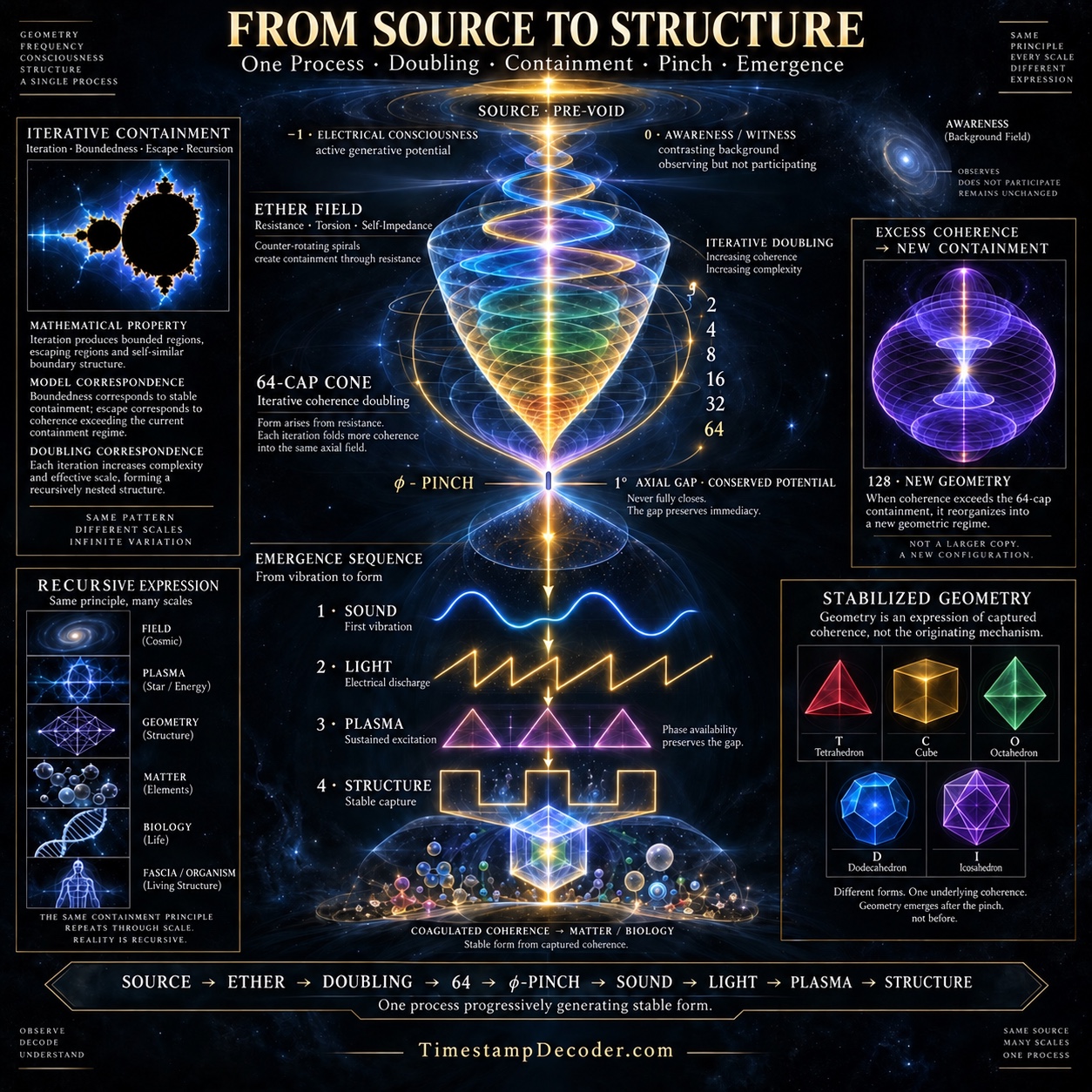
The plate depicts one proposed procession rather than independent layers of reality. Resistance, iterative containment, the 64-cap, the preserved pinch, and the emergence sequence are presented as connected functions within one model.
Structure is the handoff point: once stable form is available, Signal Into Structure can ask what happens when a signal becomes noticeable within lived organization.
The plate distinguishes Awareness / Witness as the contrasting background rather than another transformation step. For clarity on this page, Observation names the later interpretive function in the Reactor; awareness itself is not treated as something that travels through the sequence.
The Mandelbrot, doubling, φ-pinch, waveform, recursive, and stabilized-geometry relationships in this exhibit belong to the model's conceptual architecture. Their placement here does not establish them as experimentally verified physical equivalences.
The teaching keeps three scales separate so one layer does not overwrite another.
Source, Ether, doubling, the 64-cap, φ-pinch, Sound, Light, Plasma, and Structure belong to the proposed generative formation scale.
Example: φ-PINCH
Recognition, reflection, pattern/compression, landing, observation, integration, and return are interpretive process functions. They do not redefine the formation sequence.
Example: COMPRESSION
A grounded response may be a decision, boundary, question, pause, communication, action, or another proportionate move.
Example: GROUNDED RETURN
The Reactor begins after structure is available. It demonstrates one possible interpretive movement through persistent organization—not the Source-to-Structure formation sequence, a second number system, or a mandatory route.
Before a signal becomes noticeable.
The field is available without requiring a conclusion, interpretation, or action. Play the sequence or choose a state below to study it directly.
Nothing is foregrounded yet.
The complete field remains available.
Play the full movement once, or select any process state to examine it.
SIGNAL → RECOGNITION → REFLECTION → PATTERN / COMPRESSION → LANDING → OBSERVATION → INTEGRATION → RETURN
A signal does not become meaningful merely because it appears. It encounters boundary, relationship, contrast, and context.
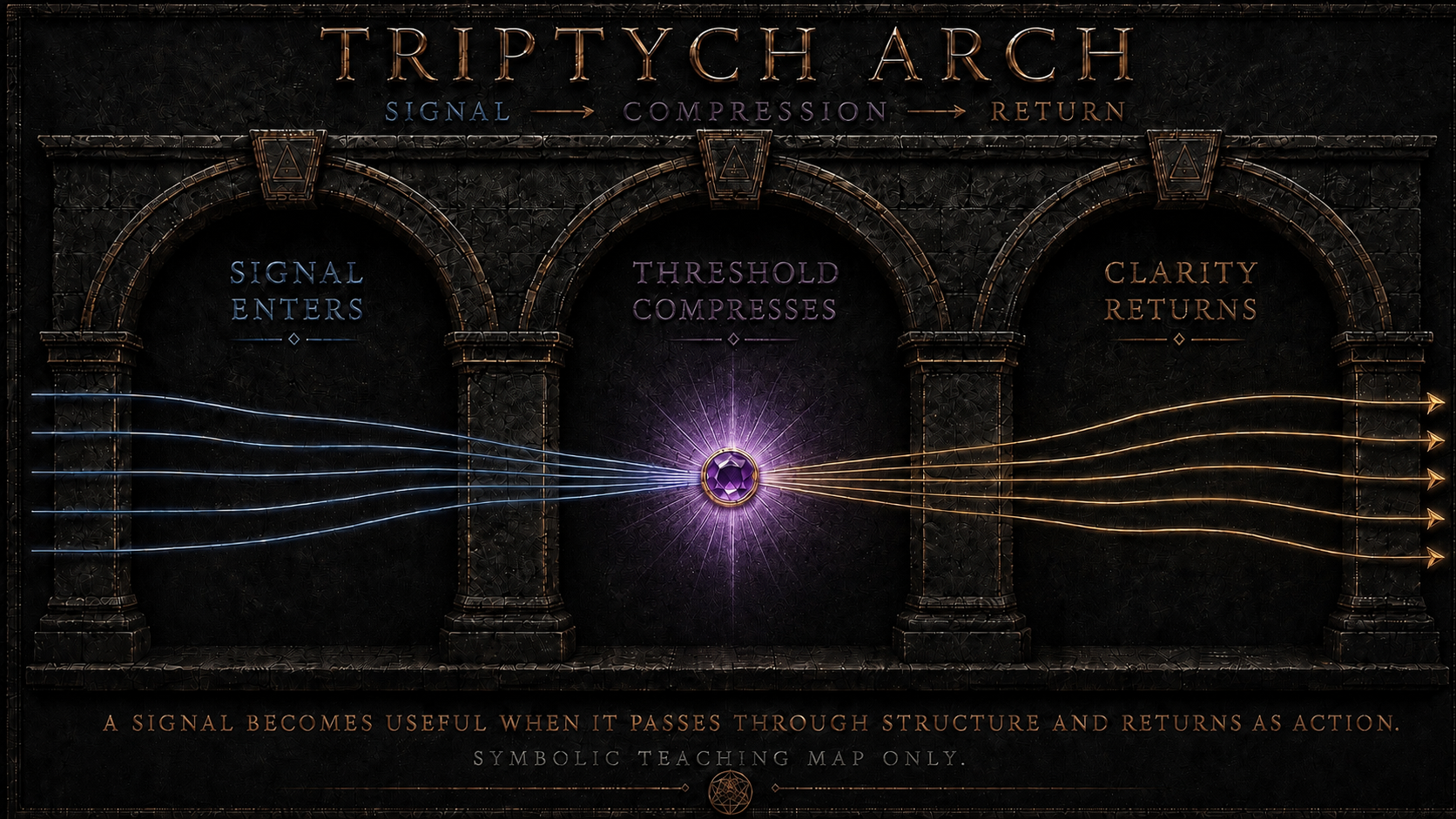
SIGNAL → COMPRESSION → RETURN
The Triptych Arch is used here as a symbolic model of entry, transformation through constraint, and clarified return. The arch represents an organized passage through which a signal can become more distinguishable.
Entry
Something becomes available to attention.
Threshold
Structure and constraint compress the signal into a more particular form.
Return
What became clearer re-enters expression.
These are descriptive exhibit functions, not numbered stages or a new ontology.
The Pulse plate has established that state can change while structure holds; the torus now narrows the question to circulation, return, and coherence within an organized field. Movement can pass through that field while the larger structure remains recognizable.
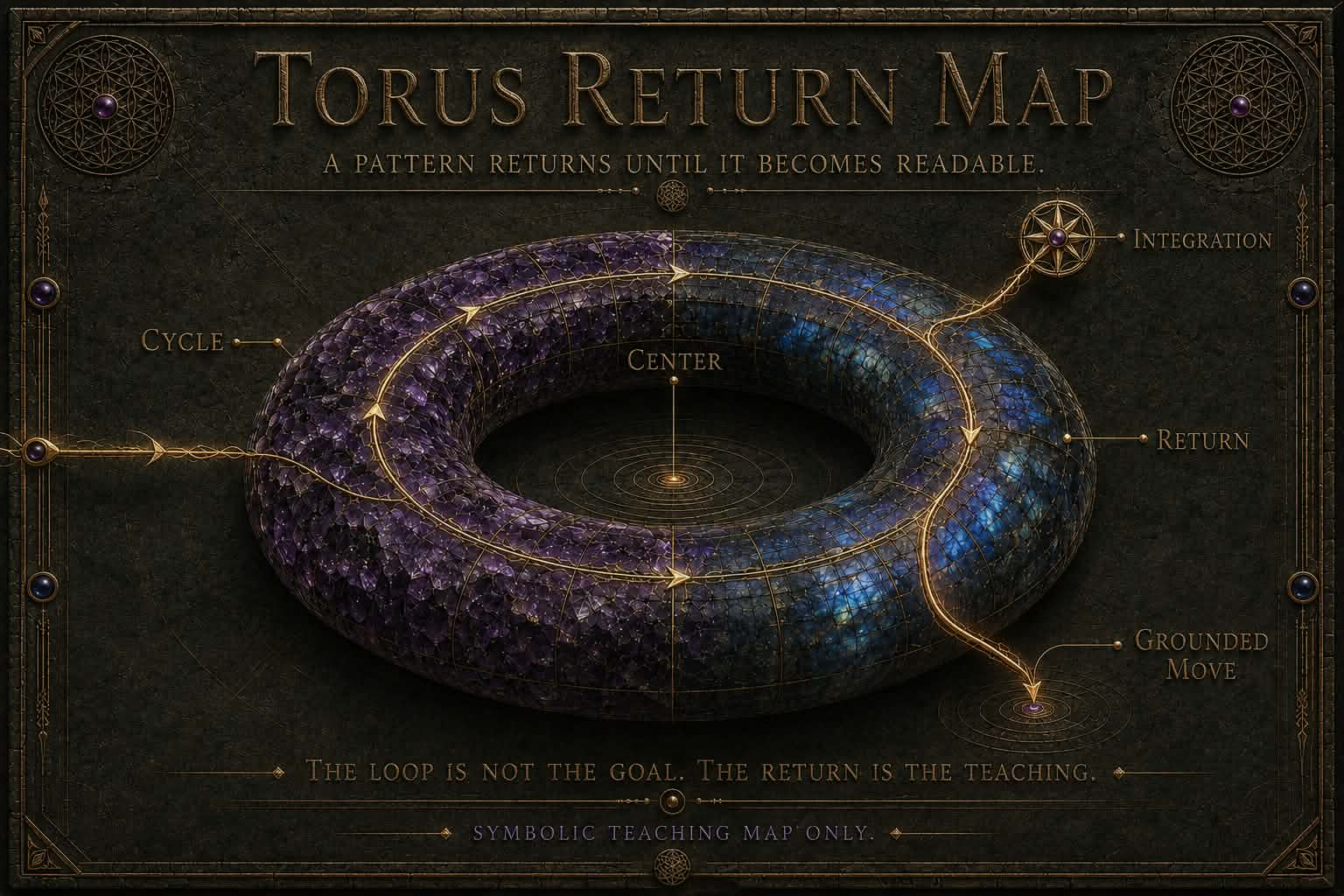
CIRCULATION → RETURN → RE-ENTRY
Circulation
Movement through organized relationships.
Return
What moves outward can re-enter the system.
Structural Coherence
Organization can persist while contents and positions change.
A repeating pattern does not exist only as an isolated cycle. When multiple patterns occupy the same system, their relationship matters.
Two repeating patterns can occupy different positions within their cycles.
When physical waves combine, their effects may reinforce or reduce one another depending on their relationship.
A driven oscillating system can respond more strongly when the driving conditions align with one of the system's natural modes of response.
Signal Into Structure uses structural coherence more broadly to describe recognizable organization persisting through movement, exchange, and changing state. Physical interference, resonance, and wave coherence retain specific measurable meanings; their presence here does not mean every symbolic, psychological, or relational pattern is a physical wave.
The visual center provides orientation across movement. It is not automatically a source entity or an additional formation stage.
Localized expression takes shape where movement encounters enough boundary to hold distinction without complete closure.
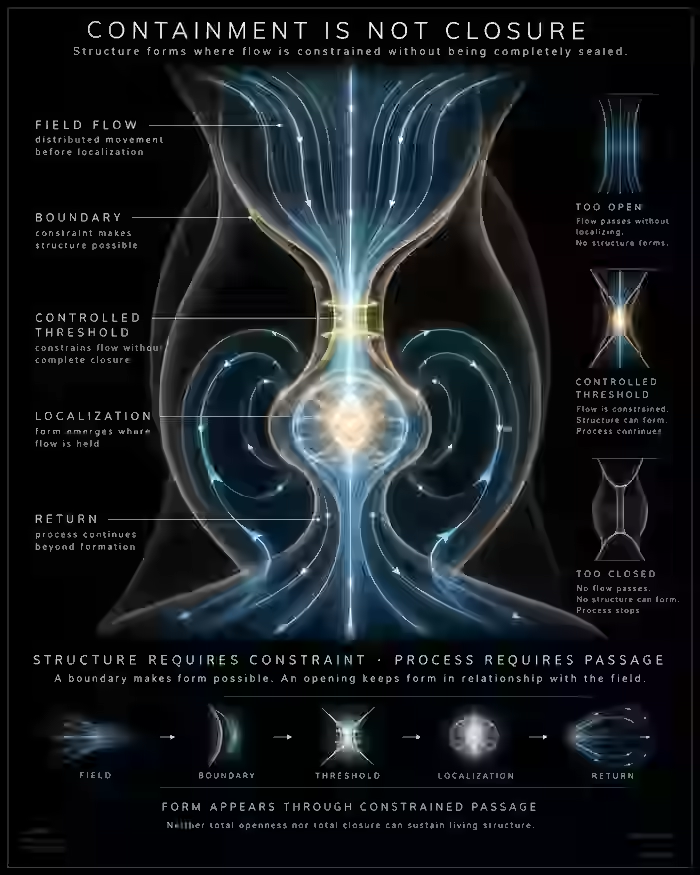
Within an already organized structure, movement can become more local and specific when it encounters enough boundary to hold distinction while retaining enough passage to remain in relationship with the wider field.
THIS IS THE THRESHOLD WHERE MOVEMENT BEGINS TO HOLD A LOCAL SHAPE.
Compression describes increasing constraint. As a pattern becomes more specific, some expressions remain available while others fall away.
NUMBER-FREE INTERPRETIVE PLATE
These are interpretive pathways. They are not formation stages, numerical meanings, or a claim that identity must harden along this route.
Constraint
Conditions limit what can occur.
Selection
Some expressions become more available than others.
Specificity
The pattern takes a more definite form.
Localization
Expression becomes situated within a particular context.
Compression can support clarity. It becomes hazardous when a useful description hardens into an unquestionable identity, role, or conclusion.
This section describes interpretive specificity after Structure is available. It does not recalculate the Source-to-Structure formation model.
Body Landing describes the point at which an organized pattern becomes sufficiently local to register in embodied experience.
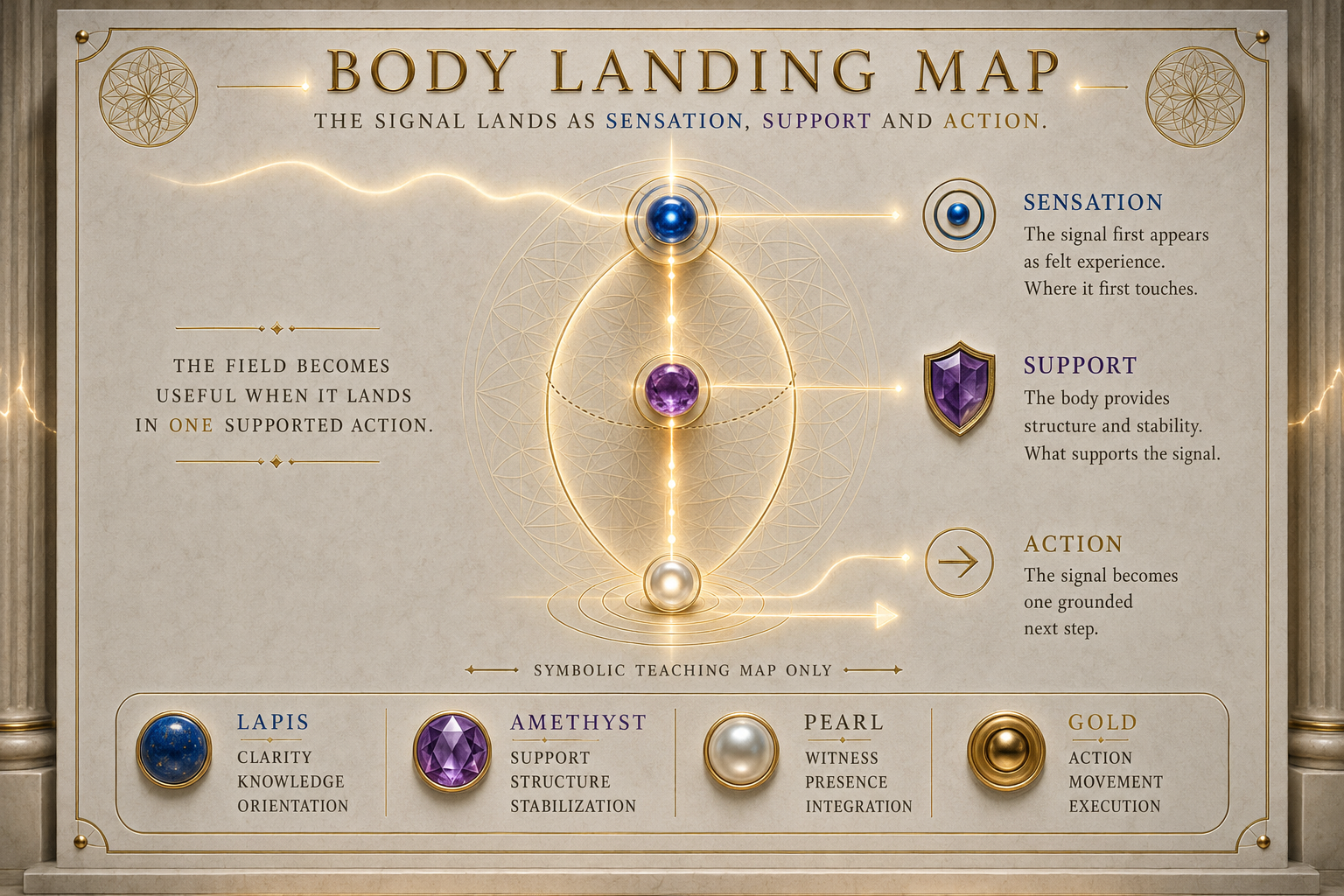
ORGANIZED SIGNAL → LOCAL EXPRESSION → LIVED CONDITIONS
A pattern may register through sensation, capacity, regulation, material limits, support needs, or practical action. Body Landing is a process function that may contact several structures; it is not another meaning for a number.
Body Landing does not claim that every symbolic signal causes a physical response. It demonstrates that a useful interpretation must eventually remain proportionate to lived conditions.
Observation creates room to examine what has landed without becoming completely identified with it. Integration places what became clear into a wider and more proportionate understanding.
Awareness remains available throughout; Observation names the deliberate interpretive function of viewing the landed pattern with context, discernment, and proportion.
Integration can synthesize the read without requiring the subject to disappear or never recur.
Once organization becomes embodied expression, that expression produces information, consequence, and response. Grounded Return carries what has been clarified back into lived conditions.
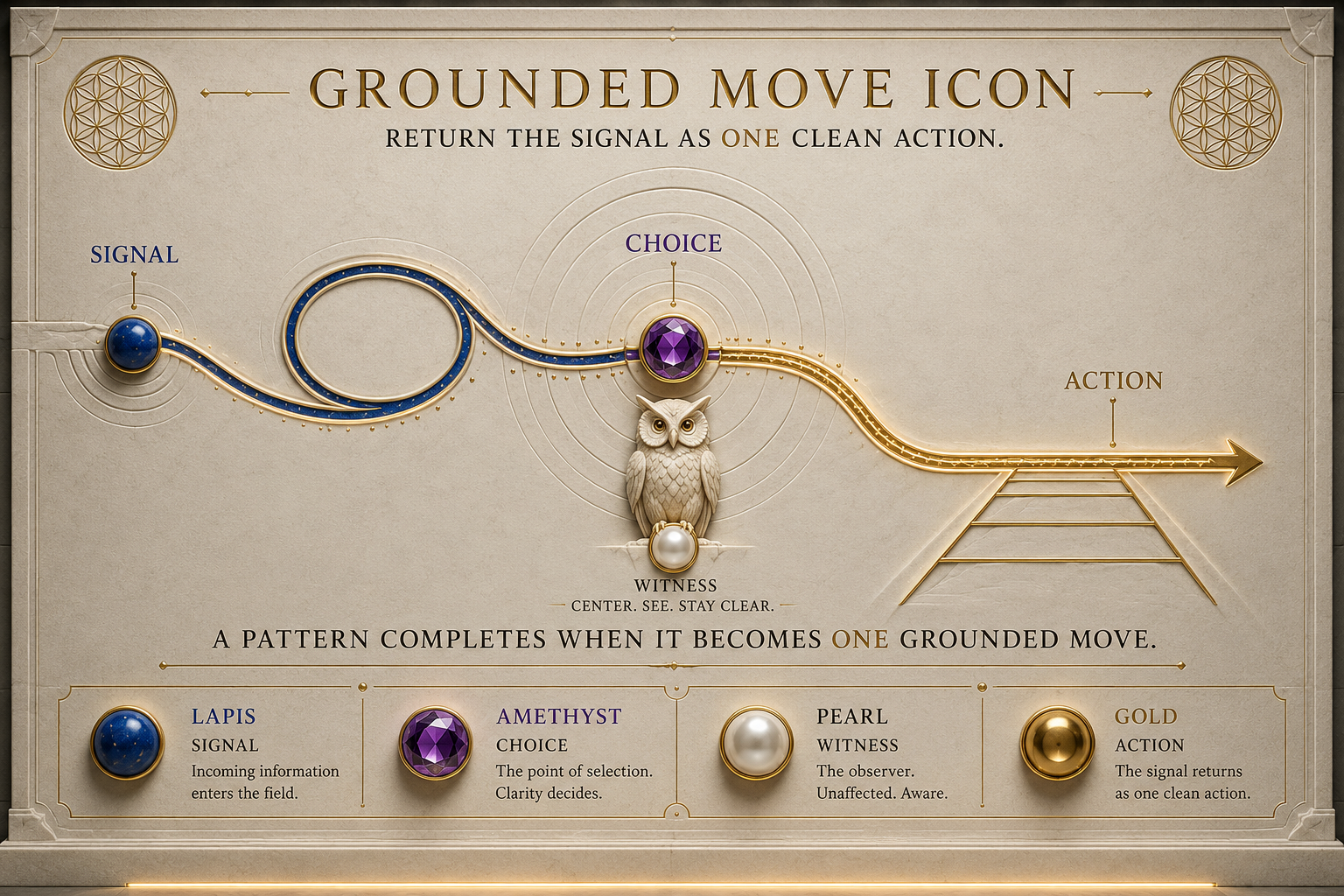
CLARITY → PROPORTIONATE EXPRESSION → FEEDBACK
A grounded move may be an action, pause, boundary, conversation, revised question, change in interpretation, or decision not to act yet.
Return does not mean the subject can never recur. It means enough clarity has emerged to change the conditions from which the next signal will be encountered.
HOW DOES ORGANIZATION PERSIST WHILE CHANGING FORM?
Timestamp Decoder identifies and measures a numeric or temporal packet. From Source to Structure supplies bounded conceptual formation context. Signal Into Structure teaches how a noticed signal can be organized, localized, observed, integrated, and returned without collapsing those functions into one system. Lucy.OS Personal Architecture applies its own governed calculation engine to an individual birth-data-based architecture; the museum plates clarify concepts but do not supply PA calculation inputs.
Measures a time, timestamp, whole number, ratio, fraction, angle, or supported language source while keeping objective calculation separate from bounded symbolic interpretation.
Uses birth data to organize an individual structural map, including permanent foundation, developmental architecture, and their continuum. It is a separate application layer rather than a direct one-to-one mapping of the Source-to-Structure formation sequence, the 27/216 geometry, or the Pulse sequence.
The packet identifies the input. The formation plate supplies conceptual context. Signal Into Structure organizes the interpretive teaching process. Personal Architecture models an individual architecture through its own governed engine.
The core interpretive sequence ends with Grounded Return. The references below preserve supporting geometry, physical examples, structural grammar, worked examples, and correspondence studies without changing the core architecture.
These exhibits remain useful as bounded studies of resolution, relationship, changing state, and repeated dynamics.
A structure can be examined at different levels of resolution without becoming a different whole. This plate promotes one verified geometric relationship into the primary sequence: a 6 × 6 × 6 chamber contains 216 unit positions, and can be divided into eight equal 3 × 3 × 3 regions of 27 positions each.
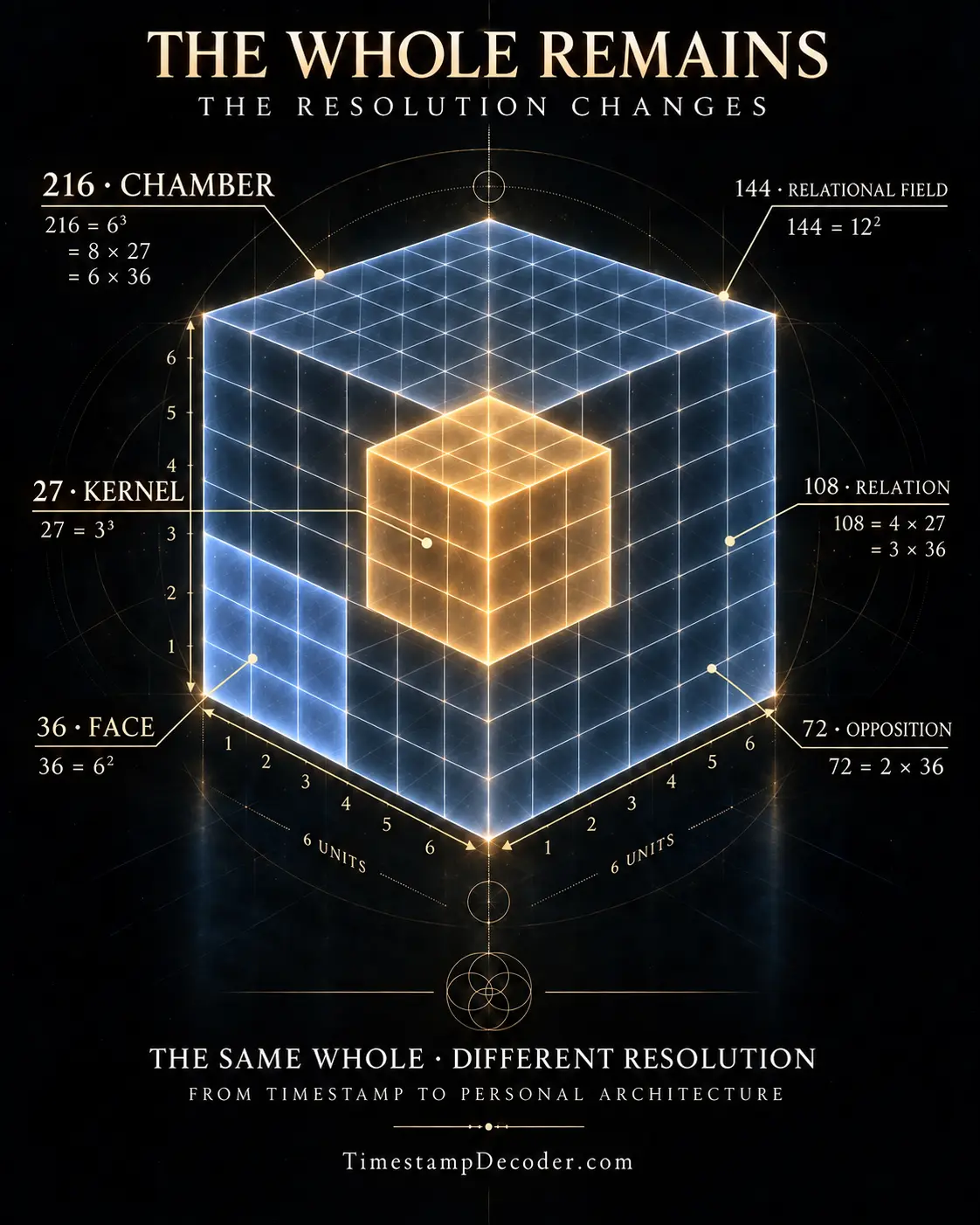
The highlighted 27 kernel is one exact half-by-half-by-half region of the 216 chamber. It does not represent a stage in the Source-to-Structure formation sequence, and the additional 36, 72, 108, and 144 readings remain geometric observations rather than new definitions for the system.
Sun–Moon–Earth geometry offers a physical demonstration of relational visibility. The Sun remains the illumination source and the Moon remains whole, while changing geometry alters how much of the illuminated lunar hemisphere is visible from Earth.
The illumination source remains continuous.
Sun–Moon–Earth geometry changes through the cycle.
The visible illuminated portion changes from the observer frame.
A crescent does not mean the Moon became crescent-shaped. The observed appearance is valid from a particular relationship and position, while the complete lunar body remains present.
Ordinary lunar phases are produced by changing Sun–Moon–Earth geometry, not by Earth’s shadow. Earth’s shadow is involved in a lunar eclipse. This exhibit uses the physical relationship as a teaching example; it does not claim that the Sun or Moon is Consciousness, mind, emotion, or a Personal Architecture calculation.
Reflection itself is not recursion. The recursive extension begins when what was perceived becomes retained meaning, memory, expectation, or structure that can influence a later encounter.
The previous exhibit changed relationship and viewpoint; this plate changes state while the chamber remains structurally recognizable. It introduces motion at the threshold between architecture and process without replacing the Signal Reactor or establishing four universal stages.
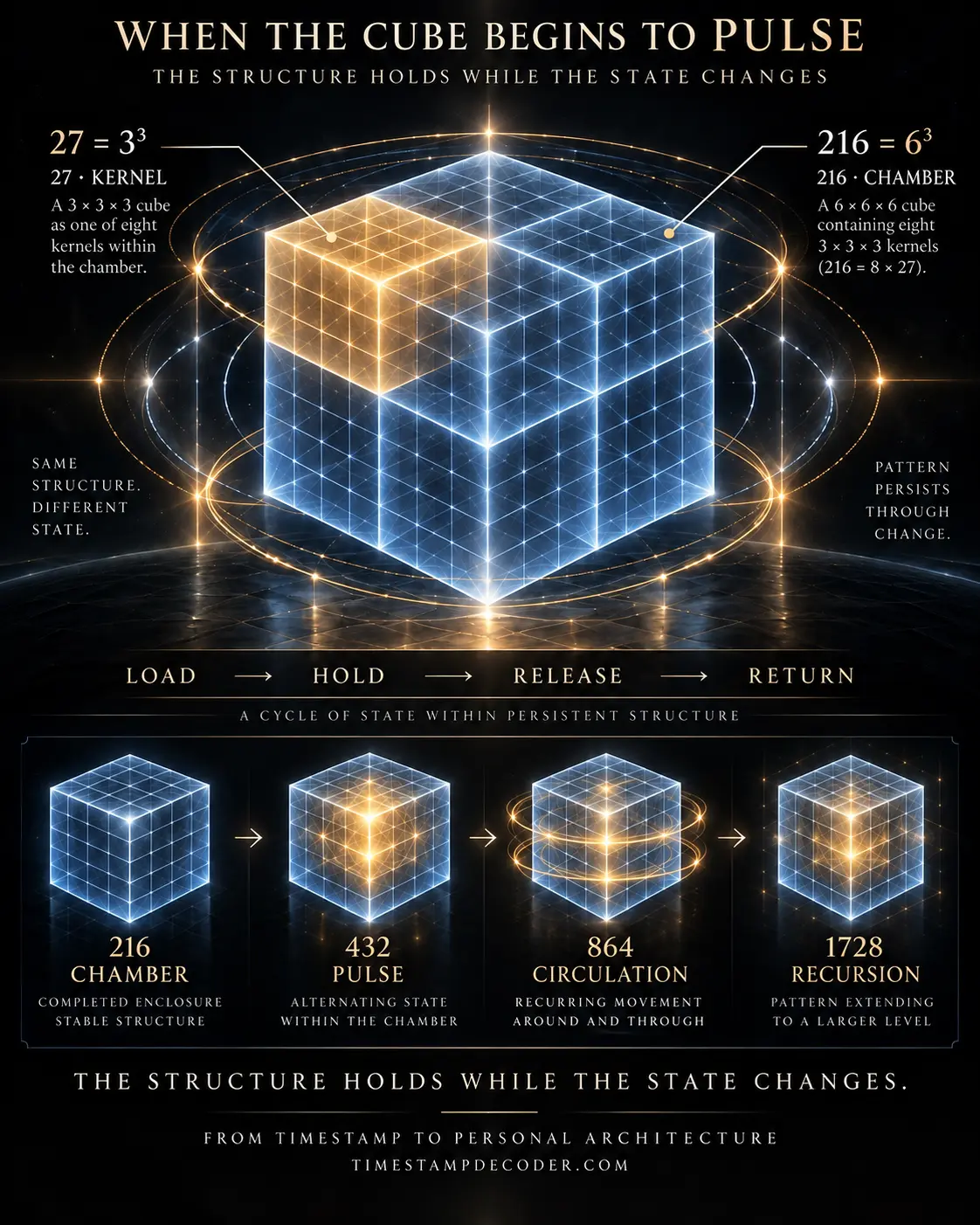
216 → 432 → 864 → 1728 names symbolic states around a preserved chamber. The sequence illustrates load, hold, release, and return without assigning those states to every process or person.
864 · Circulation does not mean “864 equals torus.” The Pulse plate is a threshold exhibit. The Reactor remains the page’s process demonstration, and none of these numbers enters Personal Architecture calculations.
The Pulse plate introduces changing state. When that change repeats through time, several additional properties become useful for describing what is happening.
How much the changing quantity varies.
How often the cycle repeats.
How long one complete cycle takes.
Where the pattern is within its cycle at a particular moment.
Change one property at a time and observe what remains constant. The display uses a normalized teaching wave rather than a physical measurement.
Period is the duration of one complete cycle. As frequency increases, period decreases. When a second signal is present, phase is shown as a relative relationship between the two patterns. The optional combined trace is scaled to remain legible inside the display.
The numbers name structures. They do not name steps in a process.
Body, matter, sensation, material conditions, and direct action.
Feeling, affect, regulation, and emotional response.
Thought, interpretation, language, and conceptual organization.
Atmosphere, context, surrounding conditions, and distributed influence.
Contact, exchange, polarity, reflection, and mutual influence.
Inheritance, memory, continuity, and accumulated pattern across time.
Group pattern, culture, shared systems, and social participation.
Deep symbolic pattern, organizing information, and transpersonal form.
Awareness of and through the architecture as a whole—not a ninth nested structure or a destination after eight.
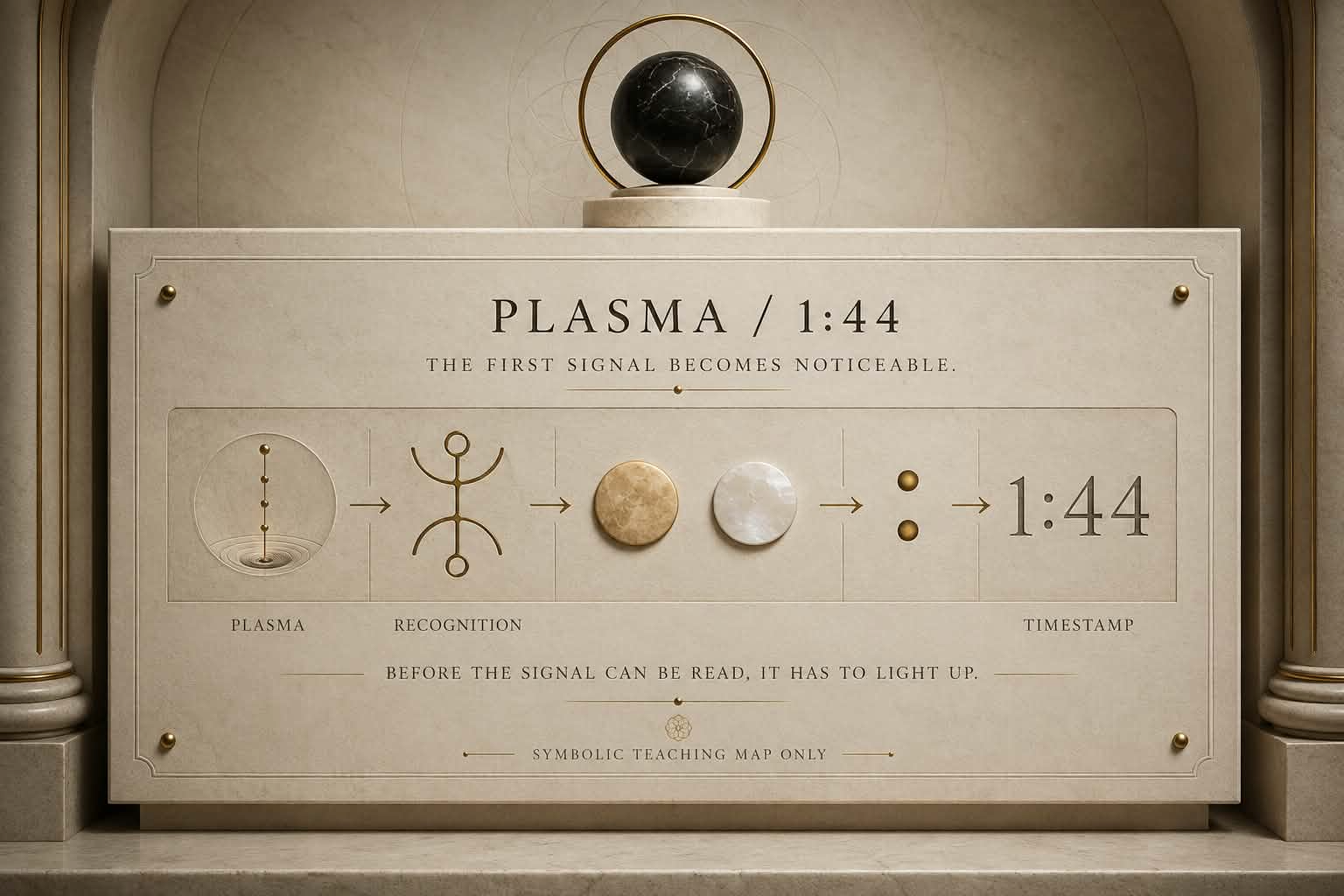
Signal recognition and a sample use of the canonical structural grammar.
PHYSICAL → FIELD EMPHASIS → CONSCIOUS RECOGNITION / INTEGRATION
This is a symbolic structural reading, not a prediction, instruction, or claim that the timestamp causes an event.
The primary sequence now carries the verified geometric relationship. This short reference preserves the equation without turning the 27/216 relationship into a formation-stage definition.
One three-by-three-by-three kernel contains twenty-seven unit positions.
One six-by-six-by-six chamber contains 216 unit positions.
The chamber divides geometrically into eight equal kernels. Those eight regions are not Source-to-Structure stages or a second ontology.
This is a geometric scaling reference, not a Personal Architecture calculation or proof of physical cosmology.
Some values recur across geometry, measurement, astronomical cycles, and historical traditions. A recurrence can be worth noticing without being treated as proof that the examples share one cause, origin, or mechanism.
The verified chamber relationship is exact: 6³ = 216. Separately, NASA gives the Moon’s mean diameter as about 2,159 miles / 3,476 km; historical NASA lunar data also records a rounded 2,160-mile value.
THE OBJECT REMAINS · THE MEASUREMENT LANGUAGE CHANGES
The numerical resemblance is a correspondence, not a demonstrated derivation of the Moon from the 216 geometry.
The Moon’s revolution period relative to the stars is about 27.3217 days. Its synodic phase cycle is about 29.53 days because the Sun–Earth–Moon relationship continues to change while the Moon orbits Earth.
SAME MOON · DIFFERENT REFERENCE RELATIONSHIP · DIFFERENT VALID CYCLE
This extends the Relational Light lesson into time; it does not assign a new symbolic meaning to either number.
Pulse: 216 → 432 → 864 → 1728 follows a doubling sequence.
Traditional yuga durations: Kali 432,000 → Dvāpara 864,000 → Tretā 1,296,000 → Kṛta 1,728,000 years belong to a historical cosmological tradition with its own proportional grammar.
216, 432, 864, and 1728 are symbolic state values in the Pulse exhibit. They are not frequencies in hertz. A number becomes a frequency only when it describes a repeating event relative to time. 432 is a number. 432 Hz is a measured rate.
SHARED NUMBERS · DIFFERENT GENERATING GRAMMAR
Numerical overlap does not establish common origin, physical causation, or derivation between the two systems.
A MATCH IS AN OBSERVATION. IT IS NOT YET AN EXPLANATION. Trace the origin, rule, unit, and context before interpreting the recurrence.
These two earlier teaching plates remain part of the supporting interpretive library. They do not define formation stages or numerical meanings.
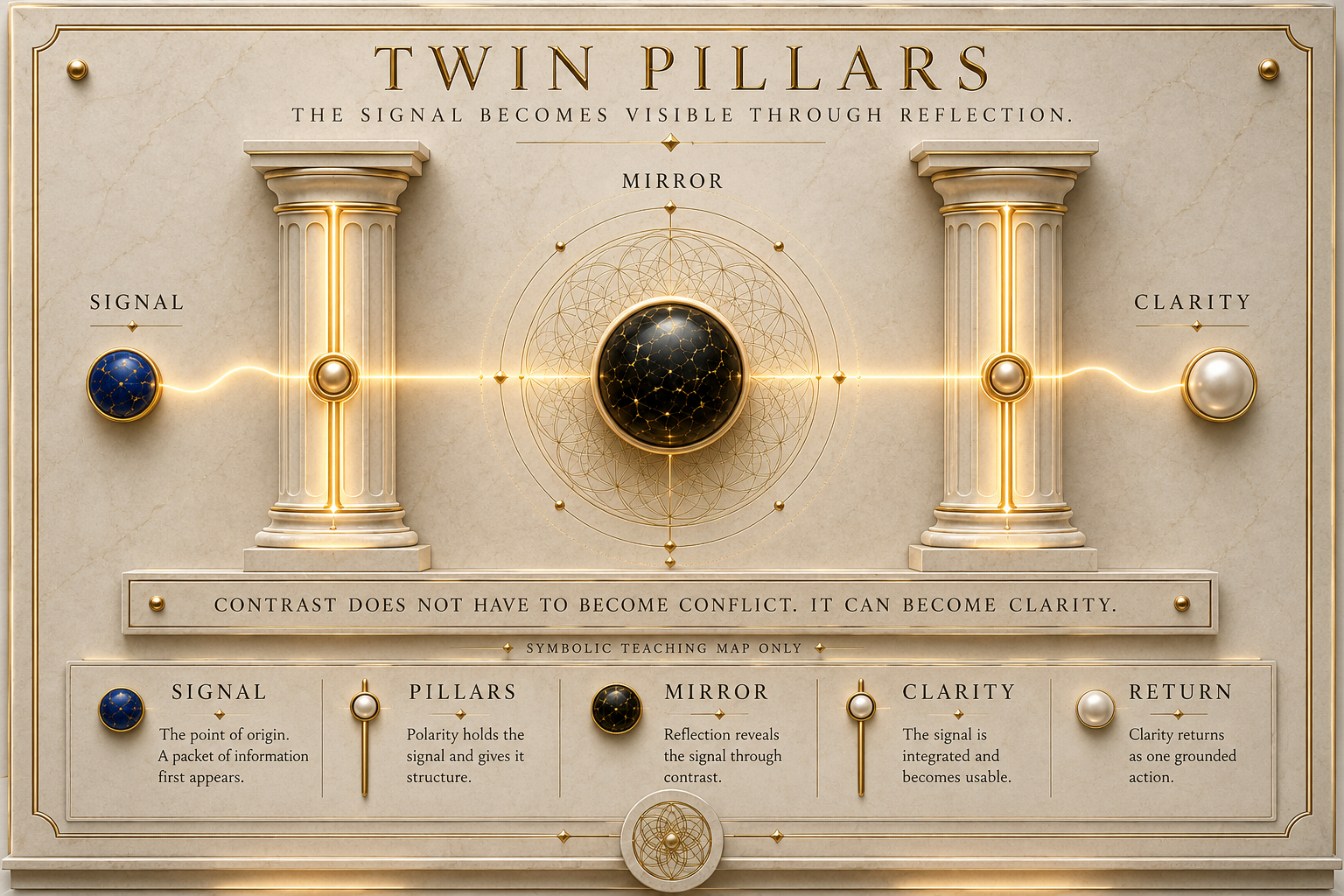
Polarity, contrast, and reflection can help make a signal more distinguishable within relationship. This is a supporting interpretive study, not the meaning of the number two and not a Source-to-Structure stage.
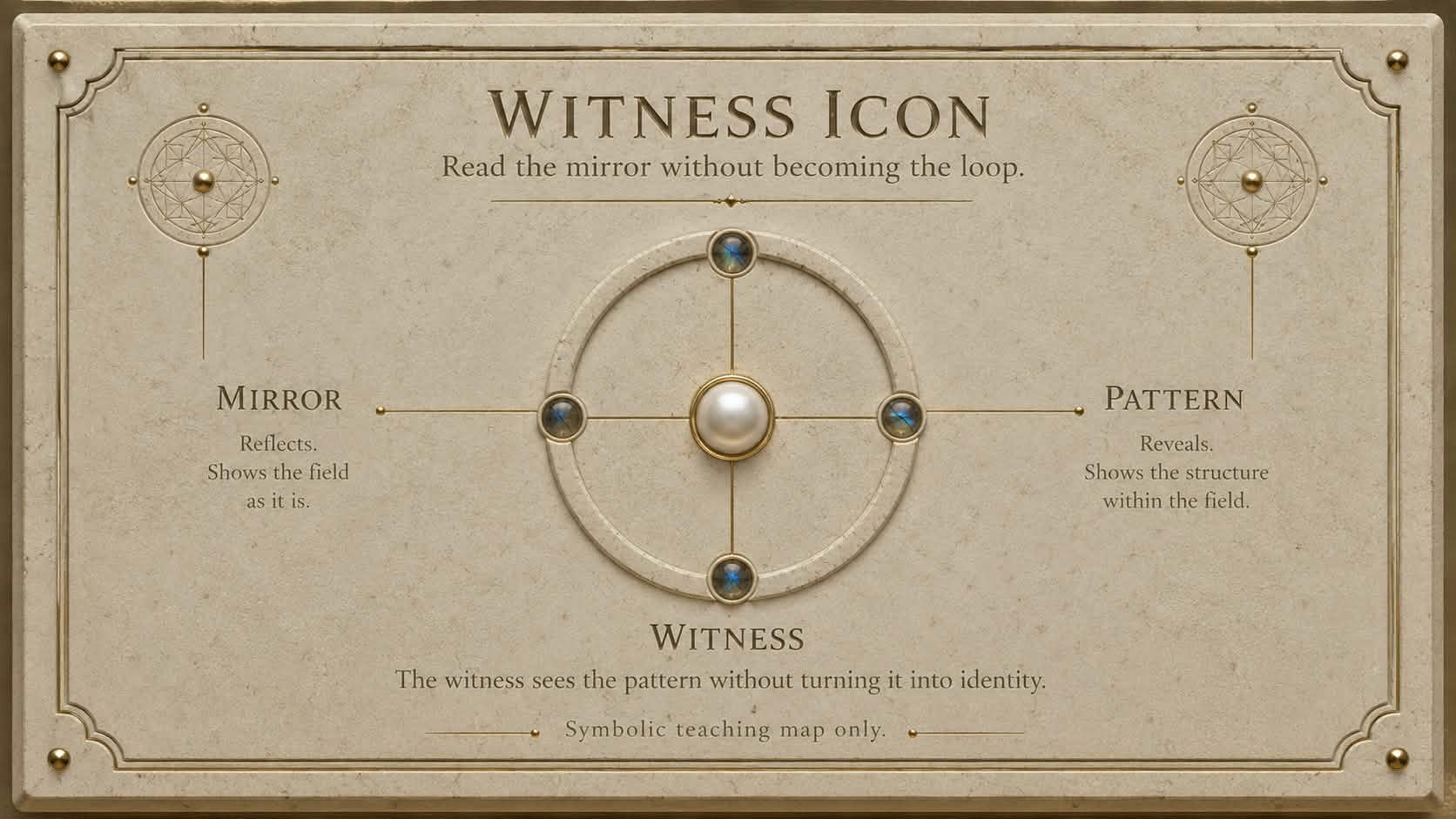
Observation names the deliberate interpretive function of viewing a landed pattern with context and proportion. It remains distinct from 0 · Awareness / Witness, which the formation model treats as the contrasting background rather than a process stage.
Signal Into Structure is symbolic teaching language. It is not medical advice, therapy, diagnosis, prediction, prophecy, proof, fate, or command. The Source-to-Structure formation model and its mathematical or geometric correspondences are not presented as established physical cosmology.
Use the formation model to organize questions about proposed structure, the Reactor to examine how meaning forms after something becomes noticeable, and grounded action to test what is useful in lived experience.
Notice the signal. Clarify the pattern. Observe in context. Integrate the read. Return grounded.